
AN INTRODUCTION TO PHENOMENOLOGICAL PSYCHOPATHOLOGY
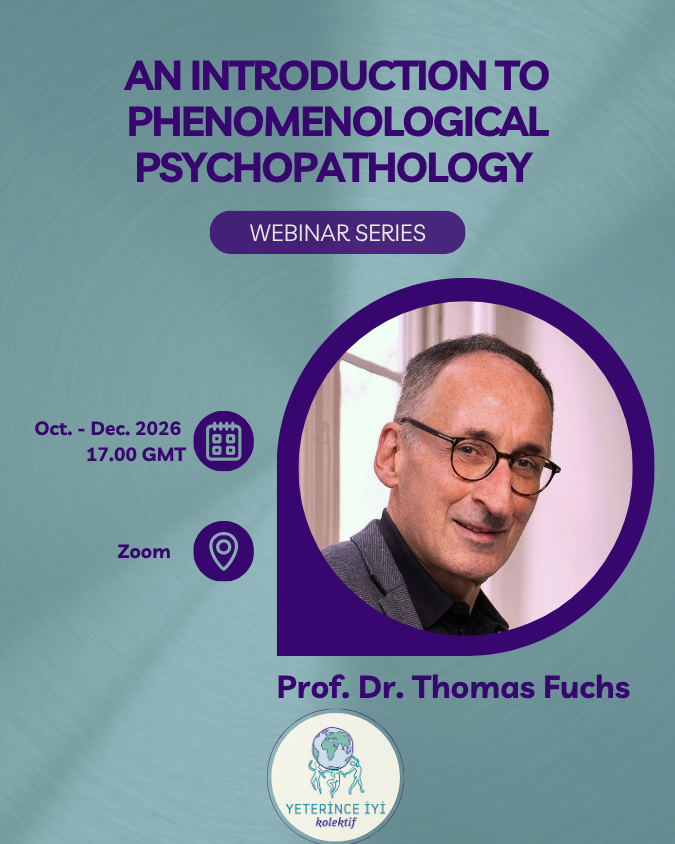
About the series:
Whatever their theoretical tradition, mental health practitioners ultimately sit with the singular experience of the person in front of them. Phenomenological psychopathology is a research and clinical framework that has developed at the intersection of philosophy and psychiatry — one that allows us to hear that experience (how a person lives time, what is happening in their body, where they struggle to be with others) without compressing it into diagnoses and symptoms. This tradition, carried forward from Karl Jaspers's principle that "psychiatry must first understand, then explain," places the transformation of the individual's relationship with the world at its centre. We believe this field holds an important richness for mental health practice both in Turkey and worldwide, and that Prof. Fuchs's phenomenological psychopathology framework will deepen our capacity to hear the subjectivity of experience in clinical practice and strengthen the helping relationship.
About the lecturer:
Thomas Fuchs is the Karl Jaspers Professor of Philosophy and Psychiatry at Heidelberg University and former Head of the Section for Phenomenological Psychopathology and Psychotherapy. Both a psychiatrist and a philosopher, his research brings together phenomenological anthropology, psychopathology, and the theory and ethics of psychiatry and neuroscience. He has authored more than 300 articles and book chapters; his major books include Ecology of the Brain (Oxford University Press, 2017), In Defense of the Human Being (Oxford University Press, 2021), and Psychiatry as a Medicine of Relations (2023). He is Chairman of the German Society for Phenomenological Anthropology, Psychiatry and Psychotherapy (DGAP).
Programme:
Session 1 (26.10.2026) — Ground: Why Phenomenology? What Has Psychiatry Lost? Key themes: The limits of the DSM, the understanding/explanation distinction, the clinical significance of a phenomenological attitude.
Session 2 (09.11.2026) — Body: The Lived Body and Mental Illness Key themes: Hyperembodiment (depression), disembodiment (schizophrenia). Phenomenological observation for the clinician.
Session 3 (23.11.2026) — Time: Disturbances of Inner Time Key themes: The transformation of temporal structure in melancholia, psychosis and obsession. Introduction to the EASE instrument.
Session 4 (07.12.2026) — Being-Together: Intercorporeality and Psychopathology Key themes: Enactivism, intersubjectivity, the phenomenology of the therapeutic relationship.
Session 5 (21.12.2026) — Integration: What Does a Phenomenological Attitude Do in Clinical Practice?
Dates: 26 October, 9 November, 23 November, 7 December, 21 December 2026 — Every Monday, 20:00 Istanbul / 17:00 GMT
Format: Online (Zoom) · 90 minutes · Simultaneous Turkish interpretation
Language: English — open to participants from outside Turkey
For: Psychiatrists, psychologists, psychological counsellors, social workers, psychiatric nurses, psychoanalytic and existential clinicians, mental health academics, and postgraduate/specialist/doctoral students.
Certificate of participation will be issued
Limited places Registration fees:
Early registration (deadline 15.08.2026):
Student / Resident: €200
Clinician / Specialist: €320
Standard registration (deadline 01.10.2026):
Student / Resident: €270
Clinician / Specialist: €420
Registration form: https://forms.gle/jkoLvCcpeHckXDKHA
For enquiries: yeterinceiyiegitim@gmail.com
Alakalı Gönderiler
-

Psikomitoloji Semineri
16 Temmuz 2026 -

Prof. Dr. Bilgin Saydam ile Süpervizyon Grubu
4 Temmuz 2026 -
.png)
FENOMENOLOJİK PSİKOPATOLOJİYE GİRİŞ SEMİNERİ
4 Haziran 2026